Charleston Water Bill Relief: Payment Plans and Aid
A water bill that arrives after a job loss, medical expense, or unexpected leak can be hard to manage—especially when you are unsure whether help is available. Charleston Water bill relief may involve a payment arrangement, a bill review, or outside assistance, but options and eligibility can change. Start by confirming who bills your address, then contact that provider before the balance grows.
First, confirm who bills your address
“Charleston Water” can mean different things to customers: the water provider, a landlord or property manager who includes water in rent, or another entity that bills for water and sewer service. The name on the bill is the best starting point. Check it before calling or applying for aid, because an assistance program may only work with certain providers or account types.
If you receive a bill directly, find the account number, service address, amount due, due date, and any past-due balance. If the bill includes both water and sewer charges, note each separately. That information will help the provider understand whether you need time to pay, a charge reviewed, or help resolving a higher-than-usual bill.
If water is included in rent, ask the landlord or property manager who holds the utility account and what portion of the bill is assigned to your household. A renter may not be able to make a payment arrangement directly with the water utility if the account is in the landlord’s name. The utility may also be unable to discuss account details with someone who is not the named customer. For a renter-specific look at funding changes and eligibility questions, see Can South Carolina Renters Still Get LIHWAP Water Help?.
If you are unsure which provider serves the address, check a recent bill, lease, closing paperwork, or the provider’s official website. The provider named on a bill might not be the same organization that manages the water source or sewer system. For help identifying the account holder and service area, see Finding Your South Carolina Public Water Provider on a Bill.
Once you know who bills you, ask what options are available for your account today. Do not assume that a program described online is still open, applies to your address, or can stop a scheduled collection action. Current terms, application windows, and eligibility rules should be confirmed with the provider or the organization offering aid.
What kinds of help to ask about
There is no single relief option that fits every household. A payment arrangement may make a past-due balance easier to manage, while a bill review may be more useful if a leak or billing issue caused the increase. Outside assistance, when available, may have separate eligibility rules and payment procedures.
| Type of help | When it may be relevant | What to ask |
|---|---|---|
| Payment arrangement | You owe a balance but can pay it over time | What payment schedule is available, and what must be paid to keep the arrangement active? |
| Short extension or due-date option | You expect money soon but cannot pay by the current date | Is a brief extension available, and does it change any pending collection action? |
| Hardship assistance | Household income or a sudden crisis makes payment difficult | Is funding open, who qualifies, and does the provider accept payments from the aid organization? |
| Bill or meter review | The reading, account, or charge may be incorrect | What records or readings can be reviewed, and how is a disputed amount handled while it is checked? |
| Leak-related review | A plumbing leak may have caused unusually high use | Is there a leak adjustment policy, and what proof of repair is required? |
| Landlord or renter resolution | The water account is not in your name | Who is responsible for the bill, and what documentation can the utility provide to the account holder? |
A payment plan is usually a way to address a balance, not a reduction in the amount owed. Ask whether new monthly charges must still be paid on time in addition to the installment amount. Also clarify whether the arrangement has a minimum payment, a required first payment, or conditions for staying current. Providers set their own terms, so get the details directly from the provider rather than relying on another customer’s experience.
Hardship aid is different. A nonprofit, public program, or community organization may pay some or all of an eligible bill, but it may require an application and supporting documents. Funding can be limited, and an award is not guaranteed. Ask whether the organization pays the utility directly, whether it covers past-due balances or only current charges, and whether the account must meet particular conditions.
For a broader overview of state and local assistance routes, see How South Carolina Water Bill Assistance Programs Work. If you need to understand how providers handle payment agreements and possible shutoff protections, South Carolina Utility Rules: Payment Plans to Stop Shutoffs and Water Bill Hardship Programs: Payment Agreements and Aid Rules offer useful context. Those general explanations do not replace confirmation of the current terms for your own account.
How to request a payment arrangement or account review
Contact the billing provider as soon as you realize the full balance will be difficult to pay. Waiting until a payment deadline has passed can reduce the time available to ask questions, gather documents, or reach an aid organization. If you have already received a notice, read it carefully and ask the provider what it means for your account. A payment plan should never be assumed to pause a pending action unless the provider confirms that it does.
Before contacting the provider, prepare a short, accurate picture of the situation:
- Your account number and service address
- The amount you can pay now, if anything
- A realistic amount you could pay regularly
- The date you expect income or other funds
- Whether the hardship is temporary or ongoing
- Any unusually high bill, suspected leak, or disputed charge
- Any notice or prior agreement related to the account
Then ask direct questions. For example: “What payment arrangements are currently available for this account?” “Do I need to make an initial payment?” “Must I keep paying new charges while paying down the old balance?” “If I apply for outside assistance, what information does the organization need from the utility?” “Will an arrangement change any pending collection action?” The goal is to understand the actual conditions, not just to hear that a plan may be possible.
If a representative offers an arrangement, write down the payment dates, amounts, accepted methods, and any conditions. Ask how the agreement will be confirmed and how to check that a payment has posted. Keep a copy of any written terms and proof of each payment. If the terms do not match what you can realistically afford, say so before accepting. Missing an unaffordable installment may leave you in a worse position than asking about another option first.
If the account is already subject to a notice or collection step, ask what action is scheduled and what, if anything, will change if you make a payment or enter an agreement. Do not rely on a general statement that “the account is being handled”; ask for the effect on your particular account and request confirmation through the provider’s official process.
A plan can be helpful, but it may not address why the balance rose. If the latest bill is unusually high, ask whether the reading was actual or estimated, whether the meter can be reviewed, and how the provider handles a possible billing error. For common payment-plan questions and Charleston-specific context, see Payment Plans and Cutoff Protection for Charleston Water Customers and What Happens When You Fall Behind on a Charleston Water Bill?. For general questions about installment terms, Deferred Water Bill Payment Terms for South Carolina Homes may also help you prepare.
Look for the cause of a high bill before agreeing to pay it
A water bill can rise because of greater household use, an irrigation or outdoor leak, a running toilet, a plumbing failure, a meter-reading issue, or a change in how sewer charges are calculated. A payment arrangement can give you time, but it will not correct a leak or resolve an incorrect charge. If the bill is much higher than normal, ask for an explanation and investigate the cause at the same time.
Compare the bill with recent bills. Look at the billed water use, meter reading, billing period, and any notation that the reading was estimated. A longer billing period can make a total seem unusually high even if daily use changed little. If the bill includes sewer charges, review how those charges are calculated and whether they track metered water use. How South Carolina Utilities Calculate Sewer Charges on Metered Water explains why sewer charges can be a significant part of a combined bill.
Check for signs of a household leak: a toilet that refills when no one has used it, damp areas, unexplained water sounds, or a meter that continues to register use when taps and water-using appliances are off. Only do checks that are safe and appropriate for your plumbing setup. If you find a leak, arrange repairs and keep the invoice or other proof of the repair. Ask the provider whether it has a leak adjustment policy, what conditions apply, and what documents it accepts. A credit is not automatic, and policies can differ.
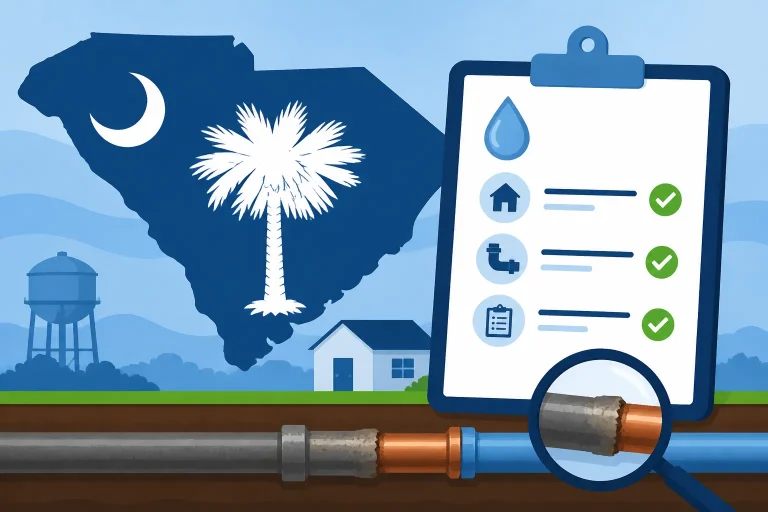
If you suspect a leak on the provider’s side or are unsure which pipe is responsible, do not assume the utility or homeowner must pay for every repair. Responsibility can depend on where the leak is and the rules for the service connection. High Bill From a Plumbing Leak: When Do Utilities Lower Charges?, Fixing Household Leaks: Who Does the Repair and How to Adjust Bills, and Water Leak at the Meter, Line, or House: Who Is Responsible? can help you frame the questions.
When a meter or reading appears wrong, contact the billing provider and ask about its process for checking it. Keep the bill, any photos or notes relevant to the issue, and dates of conversations. Ask how the disputed charge will be treated while the review is underway. Do not stop paying the entire bill unless the provider explains that doing so is permitted; ask whether you should pay the undisputed portion or follow another procedure.
It may also help to separate a one-time spike from an ongoing affordability problem. If the high charge came from a repairable leak, you may need both a bill review and a short-term arrangement. If regular monthly charges are unaffordable even after the leak is fixed, ask about longer-term assistance or a payment schedule that reflects your household’s ability to pay.
Find outside assistance and prepare a complete application
If the provider’s arrangement is not enough, ask whether it knows of current water-bill assistance partners or programs. You can also search for local community organizations and social-service agencies that help with utility bills. Availability changes, and a program that helped customers in the past may not be accepting applications now. Confirm eligibility, funding, and deadlines with the organization itself.
When you contact an assistance provider, explain that the need is specifically for a water or wastewater bill. Ask whether it serves your address, whether it pays the utility directly, and whether it requires a past-due notice or a shutoff-related notice. Some organizations may prioritize certain circumstances or require the utility account holder to submit the application. If you rent and the account is in the landlord’s name, ask what documentation is acceptable before spending time assembling an application.
The documents requested vary, but it is useful to have these ready:
- A recent water bill showing the account number, service address, and balance
- Identification and proof of residence, if requested
- Income or benefit information, if requested
- A past-due or collection notice, if relevant
- Proof of a recent hardship, if the program asks for it
- A landlord statement or lease information if the account is not in your name
- A repair invoice or other leak documentation if seeking a bill adjustment
Do not send sensitive documents through an unverified link or to an unconfirmed contact. Find current application directions on the official website of the utility or aid organization. Be cautious about unsolicited offers that promise guaranteed bill forgiveness, ask for unusual payment methods, or request account credentials. A legitimate organization should be able to explain its role, eligibility rules, and how funds reach the provider.
You can also ask whether an aid application can be considered alongside a payment arrangement. The utility may still expect some payment while an application is pending, and applying for assistance does not necessarily pause collection activity. Get a clear answer about what to do during the review period. Keep the application confirmation, case number, and any messages from the organization. If an application is denied, ask whether you can correct missing documentation, appeal, or reapply when funding becomes available.
A nonprofit or government assistance program may have limited funds, so it is wise to pursue more than one appropriate route rather than wait for a single application to resolve everything. At the same time, avoid submitting duplicate applications if the organization says that duplicates could delay review. Record the date, the person or department contacted, what was requested, and the next step.
Renters, landlords, and household account responsibility
Renters often face a different problem from customers who hold the utility account themselves. If water service is billed to the landlord, the utility’s customer is usually the account holder, and the renter may not have authority to negotiate the balance directly. The lease may explain whether water is included, billed separately, or allocated among units. Review it and ask the landlord for a copy of any water bill or calculation used to charge your household.
If the landlord says the water is about to be shut off or has already received a notice, ask for the provider’s written information and the expected next steps. A tenant should not assume that paying the landlord will resolve the utility account unless the landlord confirms how the payment will be applied. Keep receipts and written messages. If the landlord is not responding, a tenant-rights organization or qualified housing professional may help clarify local rights and options.
If your unit has its own meter or account, check whose name appears on the bill. A renter listed as the customer may be able to ask the provider directly about the account, but program rules can still vary. If the account belongs to a roommate, family member, or property owner, ask what authorization is needed before contacting the utility about account details.
For renters, the practical priority is to establish three things: who is responsible under the lease, who holds the utility account, and what immediate action the provider has scheduled. Then contact the appropriate party and ask for written confirmation of any arrangement. If you are seeking assistance, check whether the program can help a tenant whose name is not on the utility account or whether the account holder must apply.
Frequently Asked Questions
Can Charleston Water lower my bill if I cannot afford it?
A provider may offer an arrangement or direct you to an assistance partner, but a lower balance or grant is not guaranteed. Ask what current options apply to your account and whether you must meet eligibility requirements.
Should I wait for assistance before making a payment?
Do not assume that an application pauses a due date or collection action. Ask the utility what is expected while an application is pending, and ask the aid organization how long review may take.
What if my bill is high because of a leak?
Contact the provider to ask about its review or adjustment policy, and arrange repairs as appropriate. Keep proof of the repair and ask what documentation is required. Adjustments are subject to the provider’s current rules and may not be available in every situation.
Can a renter request help with a water bill?
Possibly, but it depends on who holds the utility account and the assistance program’s rules. Check the lease, identify the account holder, and ask the aid organization what documents it accepts from renters.
Disclaimer
This article is for general informational purposes only and does not constitute professional advice. Laws, prices and regulations vary by location and change over time. Consult a qualified professional for guidance on your specific situation. South Carolina Water Guide is not a government agency or water utility and is not affiliated with any public water system.