Mount Pleasant Tap Water: Well Blends and Purchased Supplies
If you live in Mount Pleasant, your tap water may come from more than one source. The town’s supply can include groundwater from wells and water purchased from other public systems, so the mix is not necessarily identical at every moment or address. Here’s how to identify your provider, understand the blend, and use the right water-quality report for your home.
Who supplies tap water in Mount Pleasant?
Mount Pleasant Waterworks is the local water utility for many homes and businesses in Mount Pleasant. But a town boundary does not always tell you which provider serves a particular address. Service areas, annexations, and connections between water systems can make the answer less obvious than the mailing address suggests.
Start with the water bill. The provider named on it is usually the best first clue. If you are moving, renting, or do not have a bill, ask the property owner or management company, or use the provider’s official website to look for service-area information. Finding Your South Carolina Public Water Provider on a Bill explains what to look for on a statement.
This matters because the provider is responsible for operating the system that delivers water to your property and for making its water-quality information available. A nearby street may be served by a different system, and a property can receive water through a wholesale arrangement even if the water is ultimately delivered by a local utility.
A practical way to confirm the setup is to check:
- The utility named on the bill. Look for the water provider, not only the company handling billing or property management.
- The service address. Make sure you are checking the exact property, especially near a boundary or in a newer development.
- The annual water-quality report. Find the report for the provider that serves your address, rather than relying on a report for a nearby town.
- Any wholesale or purchased-water information. The report may explain whether the system uses its own wells, receives water from another system, or combines supplies.
A public water system’s annual report, often called a Consumer Confidence Report or CCR, is the most useful starting point for understanding the water delivered by that system. It summarizes monitored results and may identify the system’s water sources. It does not necessarily describe the exact well or source that supplied water to your faucet on a particular day. For more background, see Guide to South Carolina Public Water Supplies and Tap Standards and How South Carolina Utilities Prepare Annual Consumer Water Reports.
How Mount Pleasant’s well and purchased supplies fit together
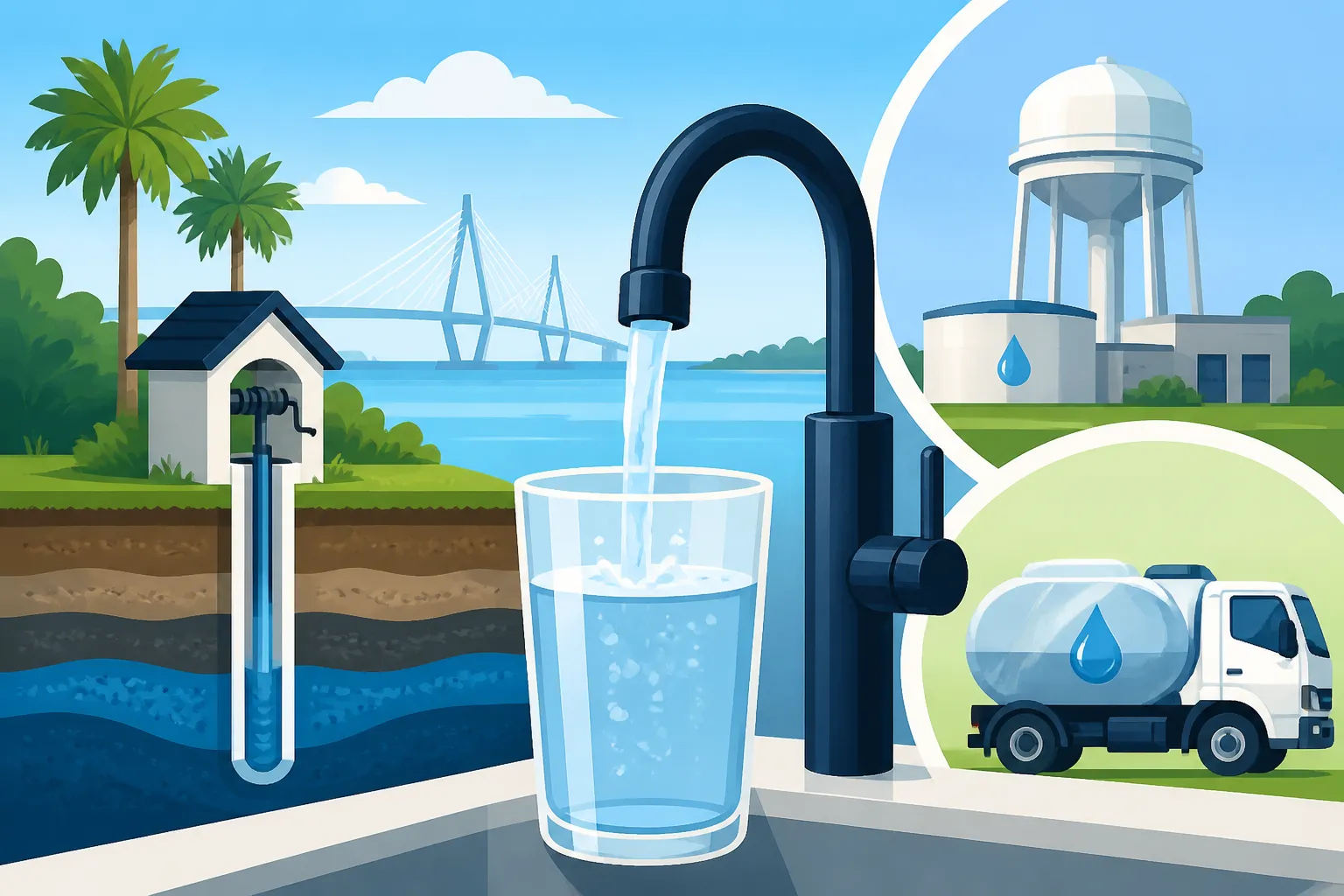
A system that uses both wells and purchased water has a mixed supply. In general, its own wells draw groundwater from underground formations, while purchased water comes from another public water system through a wholesale connection. The receiving system may distribute that water on its own, blend it with well water, or adjust how it uses each source as operating conditions change.
The words “well blend” do not necessarily mean that every gallon at every home contains water from every well. A utility may operate several wells, and their use can vary. Purchased water may also enter the distribution system at specific connection points. Water moving through a network of pipes can mix, but the proportions at a particular address depend on how the system is being operated and how water is moving through the network.
| Supply type | What it means | What to look for |
|---|---|---|
| Groundwater from utility wells | The utility pumps water from underground aquifers and sends it through the treatment process. | The report may identify groundwater sources or describe the wells and treatment. |
| Purchased water | The utility buys treated water from another public water system. | The report may identify a wholesale supplier or explain that water is purchased. |
| Combined or blended supply | The utility uses more than one source in its distribution system. | The mix can change with demand, system operations, and source availability. |
| Your home’s plumbing | Pipes and fixtures inside the property can affect water after it reaches the service connection. | A household issue may appear at one faucet or only in one building, even when the utility supply is operating normally. |
Purchased water is not the same as untreated water being piped directly from a river or well. A wholesale supplier is itself a public water system and generally treats and monitors its supply before delivering it to another provider. The receiving utility still has responsibility for operating its distribution system and providing required customer information.
At the same time, a wholesale arrangement does not mean that every source-related question can be answered by looking only at the local utility’s well information. If purchased water is part of the supply, the local report may include information about the wholesale source or direct readers to another report. Check the report for the year shown and read its source notes carefully. If they are unclear, contact the provider using contact details on its official website.
Because the source mix can vary, do not assume that one description—“well water” or “purchased water”—tells the whole story. A system may use both, and its current operating mix may differ from the mix reported for an earlier period. For a broader explanation of how groundwater and surface-water supplies are treated, see How Public Water Systems Treat Surface and Aquifer Supplies. For the Mount Pleasant source overview, Where Does Mount Pleasant Tap Water Come From? may also help you follow the local context.
Why the source mix can change
A utility operates its supply to meet customer demand while keeping the system functioning. The wells and wholesale connections available to it provide options. Which sources are in use, and in what proportions, can depend on operational needs, maintenance, demand, and the availability of each source.
That means there may not be a single fixed blend that applies to every customer throughout the year. A report can describe the sources used by the system over its reporting period, but it generally should not be treated as a live map of which source reached each home at a particular time.
Some factors that can affect the operating mix include:
- Daily demand: Water use changes over the day and across the year. The system must supply enough water while maintaining appropriate operating conditions.
- Well availability: A well may be unavailable during maintenance or other operational work.
- System maintenance: Utilities may adjust operations while repairing or maintaining treatment equipment, storage, or pipes.
- Wholesale supply arrangements: The amount of purchased water used can depend on the system’s needs and the terms and capacity of its connections.
- Water storage and movement: Storage tanks and distribution pipes help balance supply and demand, so the water flowing from a faucet may not correspond neatly to one source at that moment.
These are general features of operating a multi-source water system, not a claim that any particular change is happening in Mount Pleasant now. For current information about an operational change, service interruption, or water notice, check the utility’s official website and announcements. Managing Water Outages, Boil Notices, and Pipe Breaks in SC covers how to respond when a disruption affects service.
An annual water report is also not a precise source tracker for each property. It is designed to communicate system-level water-quality monitoring and required information. If you need to know which sources are currently being used, ask the utility whether it provides operational updates or source information beyond the annual report.
This distinction is useful when comparing two reports. If a report lists wells and a purchased supply, it describes the system’s source arrangements during the reporting period; it does not necessarily tell you the proportion in every neighborhood. A change in listed sources between reports may reflect an operational or reporting change, but the report alone may not explain the reason. Ask the utility if that detail matters to your question.
What a mixed supply can mean for taste and water quality
Different sources can have different mineral content and other characteristics. A change in the source mix may sometimes be noticeable as a modest shift in taste, odor, or the way water behaves with soap. But taste and smell cannot reliably identify the source, and a change in taste by itself does not establish whether water meets drinking-water standards.
Water may also taste different because of factors unrelated to the source blend. Chlorine or another disinfectant can have a noticeable taste or smell. Stagnant water in household plumbing, a dirty faucet aerator, a water heater, or work on a nearby main can also affect what comes from a particular tap. The location and pattern of the change can help narrow down where to ask questions:
- One faucet only: A clogged or dirty aerator, fixture, or branch of household plumbing may be involved.
- Hot water only: The water heater or hot-water plumbing could be contributing.
- Several cold-water taps: The issue may involve the home’s plumbing or the incoming supply.
- Multiple homes or nearby streets: A wider distribution-system condition may be more likely and is worth checking with the utility.
- A sudden change after a water notice or repair: Follow the utility’s current instructions and ask whether the work could explain what you are noticing.
This is a troubleshooting framework, not a way to diagnose water safety. If the utility has issued a notice, follow its instructions instead of relying on taste, smell, or appearance. If you have a health concern about water, contact the local health department or a medical professional. For everyday troubleshooting, Odd Water Taste, Smell, or Color: Is It the Utility or Your House? and Does Weird-Tasting or Smelly Tap Water Mean the Utility Is Unsafe? can help distinguish common household clues from questions for the provider.
The annual report is a better place to check monitored water-quality results. Look for the reporting period, the source description, the contaminants listed, and any explanations of detected levels or violations. A contaminant detected in a report does not automatically mean the system violated a standard; the result has to be understood in the context of the applicable benchmark, units, and reporting rules. Deciphering Contaminants and Limits on Your Annual Water Report explains how to read those details.
A CCR reports system monitoring results, not necessarily a test of the water at your kitchen faucet. Water can change as it travels through a building’s plumbing, particularly where older pipes or fixtures are present. If your concern is about lead or another plumbing-related issue, the annual report alone may not answer it. See Lead and Copper in South Carolina Tap Water: Homeowner Guide for information about the difference between system-level reporting and household plumbing concerns.
How to find the right report and use it well
The useful report is the one for the public water system that serves your address and the correct reporting period. A nearby provider’s report may describe a different source blend, treatment process, and monitoring results. If you are unsure which system serves the property, confirm the provider before interpreting results.
Use this process:
- Confirm the provider. Check a current water bill or ask the property owner or utility to verify service for the address.
- Find the report on the provider’s official website. Search the utility’s site for its annual water-quality report or CCR.
- Check the report year and system name. Do not assume the newest file in a search result belongs to your provider or covers the period you need.
- Read the source section. Note whether the report describes utility wells, purchased water, or more than one source.
- Review the monitoring results and explanations. Pay attention to units, reporting periods, and whether the report describes a detection, a benchmark, or a violation.
- Ask a focused question if the source details are unclear. For example: “Does this report include the water purchased from another system?” or “Does the source mix vary by service area?”
You can also look for water-quality reports from a wholesale supplier if the local provider’s report refers to one. That report may explain the supplier’s source and treatment, while the local utility’s report covers the distribution system that serves customers. The two reports are related but do not necessarily answer the same questions.
A report can tell you what the system monitored and summarize the results, but it may not list every possible substance or every household-specific condition. If you are trying to answer a specific question—such as whether your faucet has lead, whether a change in water taste is limited to your home, or whether a particular source is currently being used—ask the utility what information it has and whether testing is appropriate.
For questions about water hardness or mineral levels, first check whether the report includes the specific information you need. Not all reports provide the same level of detail for aesthetic characteristics. If you need a result for your home rather than a system summary, ask the utility whether it offers customer testing or consult a qualified laboratory. Comparing Water Hardness and Dissolved Solids in State Supplies provides context for interpreting those measures, while Where to Find South Carolina Water Quality Reports and Utility Tests describes ways to locate utility information.
What to ask Mount Pleasant Waterworks
A short, specific question is often more useful than asking generally whether the water is “well water” or “purchased water.” The answer may depend on whether you mean the utility’s source arrangement, its current operations, or the water at one particular address.
Useful questions include:
- Which public water system serves my exact address?
- Does the current annual report include water purchased from another system?
- Which source types are listed for the reporting period?
- Does the utility publish information about changes in the source mix?
- Does my neighborhood receive water from a particular pressure zone or connection?
- Is a recent taste, odor, or color change consistent with nearby utility work?
- Does the utility offer testing for the specific issue I am investigating?
- If the concern is inside my home, what type of sample or test would answer it?
Use the official utility website to find current contact information and any current notices. If your concern is an active outage, a boil-water notice, or a possible contamination event, check for official instructions before taking other steps.
It also helps to describe the problem precisely. Note when it began, whether it affects hot water or cold water, whether it occurs at one fixture or several, and whether neighbors notice the same thing. Those details can help distinguish a household plumbing issue from a broader supply or distribution question. They do not prove the cause, but they make a conversation with the provider more productive.
The central takeaway is simple: Mount Pleasant’s tap supply can involve both groundwater wells and purchased water, but the exact blend is not necessarily fixed or identical at every home. Confirm your provider, use its report for the relevant year, and ask the utility directly when you need current source or operational details.
Frequently Asked Questions
Is Mount Pleasant tap water only well water?
Not necessarily. The local system may use groundwater from wells as well as purchased water. Check the current annual water-quality report for the source description and any wholesale-supply notes.
Does every Mount Pleasant home receive the same blend?
Do not assume that it does. The source mix can change with operations, and water moves through a distribution network. Ask the utility whether it can explain source information for your address or area.
Can a change in taste tell me that the well blend changed?
Not reliably. Taste can be affected by disinfectant, household plumbing, faucet parts, water heaters, or other factors. A taste change alone cannot identify the source or establish water quality.
Does the annual report show which well supplied my house?
Usually, a report describes sources and monitoring at the system level rather than identifying the exact source reaching a specific faucet at a particular time. Ask the utility for more specific information if needed.
Disclaimer
This article is for general informational purposes only and does not constitute professional advice. Laws, prices and regulations vary by location and change over time. Consult a qualified professional for guidance on your specific situation. South Carolina Water Guide is not a government agency or water utility and is not affiliated with any public water system.